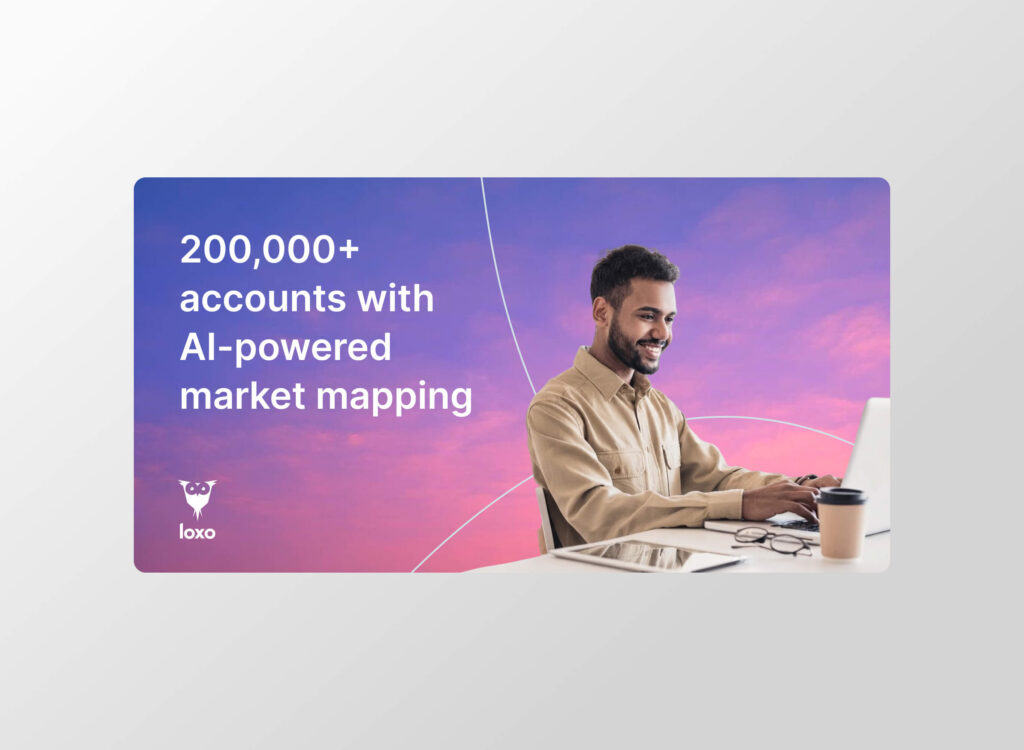
Loxo prioritized 200,000+ accounts with AI-powered market mapping
From a massive addressable market to clear account priorities
Loxo had a lean go-to-market (GTM) team and more than 200,000 potential accounts across recruitment verticals. The challenge was deciding where to invest personalized attention and where automated outreach could provide broader coverage.
The Kiln, a 2X company, helped Loxo develop an AI-powered market-mapping and scoring system that accounted for historical win rates and future growth priorities.
The engagement resulted in 200,000+ accounts scored, 15+ scoring criteria, and a data-driven framework for account targeting, outreach planning, and market reporting.
The challenge: Prioritizing a market too large for traditional ABM
While traditional account-based marketing (ABM) programs often focus on a defined set of high-priority accounts, Loxo needed to evaluate more than 200,000 potential accounts across recruitment types, industries, company sizes, and geographies. With approximately 100 team members, the company needed a way to prioritize its market without spreading its resources too thin.
The company also wanted to move upmarket. But relying on historical win rates alone risked reinforcing its existing customer mix, where smaller accounts represented much of its past success.
Loxo needed a way to evaluate its entire market while accounting for where the business wanted to grow.
The team needed to:
- Map and segment its full addressable market.
- Score accounts using historical win rates and strategic fit.
- Determine which accounts warranted high-touch engagement versus automated outreach.
- Give leadership and the board a clearer, data-backed view of the market and account priorities.
The solution: AI-powered market mapping built around future growth
1. Segment the entire market
The Kiln identified dozens of variables to classify Loxo’s potential accounts, including recruitment type, industry served, revenue, and company size.
The segmentation covered recruitment categories such as executive search, temporary staffing, and permanent placement. Loxo could also filter accounts by geography, team size, and role focus to examine specific parts of its addressable market.
2. Score accounts against historical win rates and strategic value
Using 15+ criteria, The Kiln developed a customized scoring model that weighed historical win rates against strategic value, including Loxo’s ambition to move upmarket.
Rather than prioritizing accounts solely because they resembled past customers, Loxo could identify opportunities that better matched its future growth objectives.
3. Match outreach intensity to account potential
Account scores informed a tiered outreach strategy, helping Loxo determine where its GTM team should concentrate its efforts.
Higher-priority accounts could receive personalized, one-to-one engagement, while broader or automated programs could cover other segments. This allowed Loxo to plan outreach according to account potential rather than applying the same level of effort across its entire market.
4. Automate lead-list distribution and refreshes
To put account priorities into practice, The Kiln built Clay-based automations that distributed and refreshed lead lists for outbound and business development representative (BDR) activities.
The engagement also included consulting on future plans to incorporate Common Room and engagement scoring, which could add another layer of account intelligence.
The resulting infrastructure supported ongoing targeting activities and provided a foundation for future campaigns and experimentation.
The results: 200,000+ accounts scored and a clearer GTM strategy
Loxo gained a market-wide prioritization system with three reported metrics:
- 200,000+ accounts scored: A comprehensive market map covering potential customers across recruitment verticals.
- 15+ scoring criteria: A customized model incorporating account characteristics, historical win rates, and strategic value.
- 3M+ integrations run: The reported volume of integrations executed during the engagement.
Beyond these figures, the engagement delivered several practical outcomes.
- Account priorities aligned with future growth. Loxo could identify opportunities based on its upmarket ambitions rather than relying exclusively on past customer patterns.
- A clearer plan for outreach. Account tiers helped the GTM team decide where personalized engagement warranted greater attention and where automation could extend its reach.
- More informed reporting to leadership and investors. With a detailed market map and account scores, Loxo could use data to explain its total addressable market, account coverage, and targeting priorities.
- Infrastructure for future campaigns. Clay-based automations made it possible to distribute and refresh lead lists as Loxo continued developing its GTM programs.
The engagement also established a way to track progress toward a longer-term objective: building familiarity with Loxo’s highest-priority accounts.
A clearer path from market potential to GTM action
With more than 200,000 potential accounts to consider, Loxo needed a practical way to direct its team’s attention.
The Kiln brought segmentation, scoring, and outreach planning together, giving Loxo a clearer basis for targeting decisions and the infrastructure to support future campaigns.